The Golden Ratio
- Dec 27, 2025
- 2 min read
Updated: Jan 8
What's similar between the "Mona Lisa", a galaxy and a human face? You're probably confused, but let me give you a hint- it's abstract.
The answer to the question posed is the Golden Ratio, a harmony that is present everywhere, whether in nature, human anatomy, architecture, or art. Commonly represented by the symbol Phi (Φ), its value approximates to 1.618, or (1+ √5)/2. The idea of this ubiquitous proportion stems from the concept that if a line is split into two parts, the sum of the two parts over the longer part is the same ratio as the longer part of the line is to the smaller part.
Refer to the visual below:
|---------------------------------- ---------------------|
a (34) b (21)
a+b a
------ = --- = ~1.618
a b
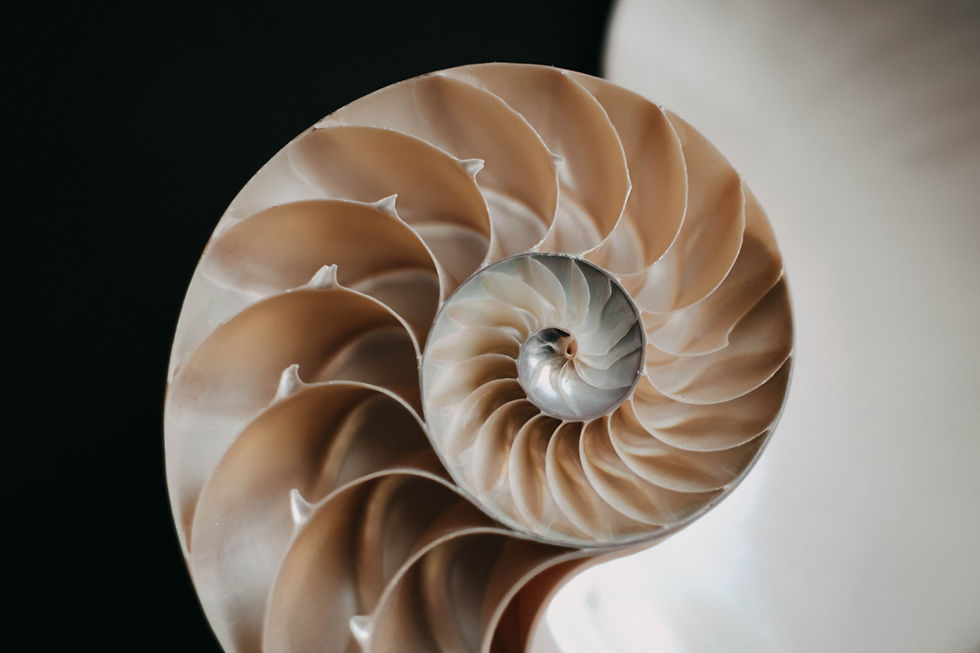
The Golden Ratio is everywhere once you start noticing it. It shows up in the spiral shapes of galaxies, the way sunflower seeds grow, the shells of nautilus, and even in hurricanes. In humans, it appears in the proportions of our faces, hands, and bodies, which is probably why some things just feel naturally balanced and pleasing to look at.
Artists and architects have been using the Golden Ratio for centuries. Leonardo da Vinci applied it in the Mona Lisa and the Vitruvian Man, and even the Parthenon in Greece follows these same principles. Today, designers, photographers, and illustrators still use it to make their work feel harmonious and balanced.
The Golden Ratio is also connected to the Fibonacci sequence, where each number is the sum of the two before it. If you draw squares with Fibonacci numbers as sides, the spiral you get ends up looking a lot like the spirals we see in nature- a simple pattern that underlies a surprising amount of beauty in the world.
Beyond art and nature, the Golden Ratio pops up in some really interesting places. Some composers, like Beethoven and Debussy, used it to structure their music, timing key changes or climaxes in ways that just feel right to the ear. Modern designers use it in logos and products, like Apple, Twitter, and Pepsi, to create shapes that are visually pleasing. Even our own bodies follow it more than we realize, from the proportions of our forearm to our hand, to the spacing between joints, and studies suggest faces closer to Golden Ratio proportions are often considered more attractive.
The Golden Ratio is also found in architecture beyond ancient buildings. Modern constructions, like the United Nations Secretariat building in New York or designs by Le Corbusier, follow Phi proportions, showing its appeal has lasted thousands of years. And at the largest scales, it shows up in hurricanes, spiral galaxies, and even in the structure of DNA.
Basically, the Golden Ratio is everywhere. From tiny cells to massive galaxies, from classic paintings to the proportions of our own bodies, it quietly creates balance and beauty that we can feel, even if we don’t always notice it. It’s a kind of universal harmony that connects art, nature, and humans in a way that is both mysterious and kind of magical.


Comments