Is Math the Hidden Masterpiece of the Universe?
- Jan 18, 2025
- 3 min read
Updated: Jan 22, 2025
Mathematics very often seems to be an abstract thing—numbers, formulas, and equations learned at school and forgotten after the test is over. Still, if you really think about it, math is so much more. It is not just the set of rules to follow; it's actually an art, a universal language, and perhaps the hidden masterpiece that changes everything around it in many ways.
Now, let's take a look at the beauty of math by exploring how its connection to nature, art, music, as well as our everyday lives in this blog post.
The Language of Nature
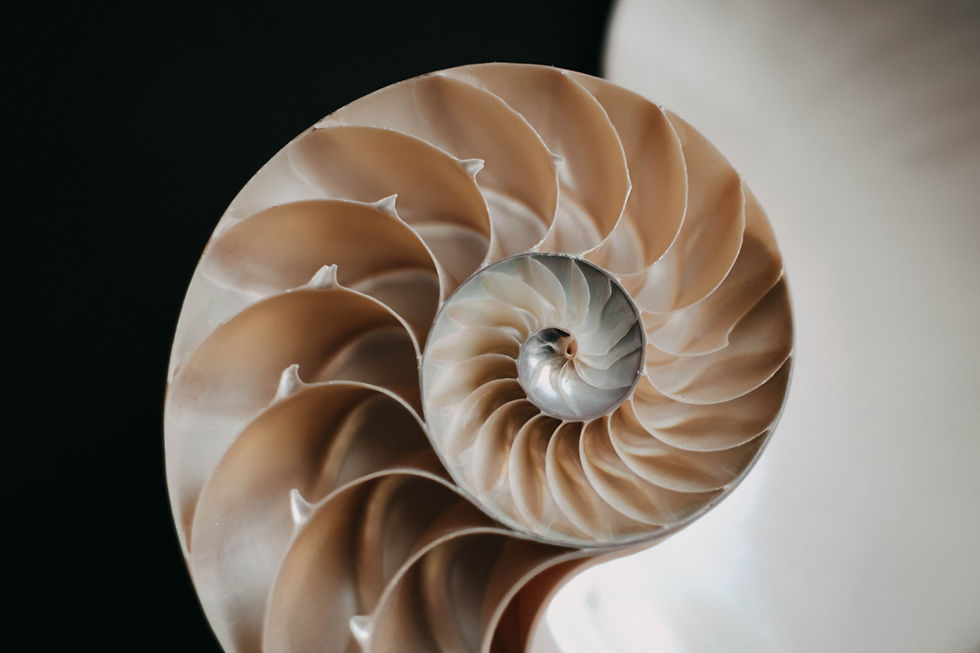
There are some really beautiful connections between mathematics and the natural world that are just astounding. Take the Fibonacci sequence. It is a simple pattern in which each number is the sum of the two preceding numbers, yet it shows up in so many places in nature. You can see it in the way leaves spiral on a stem or how branches spread out on trees. Furthermore, the golden ratio, which is roughly 1.618, is well known to appear in everything ranging from the spirals of seashells to the proportions of the human face. It's amazing how math interconnects everyone in the world
These patterns not only help us understand nature but also bring out its beauty. In fact, scientists have found that about 85% of all known plants follow the Fibonacci sequence to receive maximum sunlight. This relationship between math and nature is a beautiful example of how mathematics brings the natural world into harmony.
The Symmetry Art
Probably, one of the most striking mathematical features is its symmetry. Just like balance is beauty in a painting, maths plays an oversized role in attaining and maintaining such qualities. The human form with symmetry is balanced-just as displayed in Leonardo's "Vitruvian Man,"-or that giant Parthenon in Athens.
Math and symmetry are combined in works by artists and architects like M.C. Escher to make their works even more striking. His famous tessellations—repeated patterns—show mathematical concepts in a beautiful way. Research has shown that symmetric art is 25% more appealing to viewers, showing how much math intertwines with our perceptions of art.
Music and Mathematics
Another amazing example of how math shows up in the world is in music. The relationships between notes, rhythms, and chords are based on math. A musical scale is just a sequence of frequencies that relate to each other in simple ratios, such as 2:1 for an octave.
Composers like Johann Sebastian Bach used math in their music. Bach's "Well-Tempered Clavier," which plays with balance and symmetry across all 24 keys, shows the blend of emotion and math. Even today, electronic music artists use algorithms to create rhythms and melodies, blending emotion and math.
Aesthetic Algorithms
In the modern world, math means more than it ever did. Algorithm, which are step-by-step instructions for solving problems, are everywhere, from how we search the internet to how we interact on social media. But they aren't just practical—they can also be beautiful. For instance, the Mandelbrot set is a famous fractal pattern that seems complicated but comes from a simple mathematical formula. It's not only useful in fields like computer graphics but also visually stunning. Studies have shown that 72% of people find fractals pleasing to look at, proving that math isn't just functional—it's art.
Mathematical Puzzles as Art
Puzzles, especially Sudoku and logic puzzles, do more than entertain; they educate by building creativity and logical thinking. Solving a puzzle is an art in its own right, as every piece has to fit just right. Much like completing a beautiful painting, solving a hard puzzle leaves you with a sense of satisfaction. Furthermore, when people solve puzzles together, they grow closer, proving that mathematics unites people in their process of working.
The Ever-Changing Masterpiece
Mathematics is definitely the hidden masterpiece of the universe, influencing every part of our lives—from art to nature, science, and technology—all with its precision and elegance.
From the simplicity of patterns in nature to the complexity of designs in art, down to the sound itself, math is a universal language that crosses all borders. Its beauty lies not only in how it works but also in how it connects everything and everyone.
The next time your mind wanders to mathematics, don't just think of the equations. Visualize it as what it is: a beautiful form of art, an instrument to be creative, and a door to the deep order of the universe.

By embracing the wonder of math, we can appreciate the world around us in a new way, revealing the masterpieces hidden in plain sight.

Comments